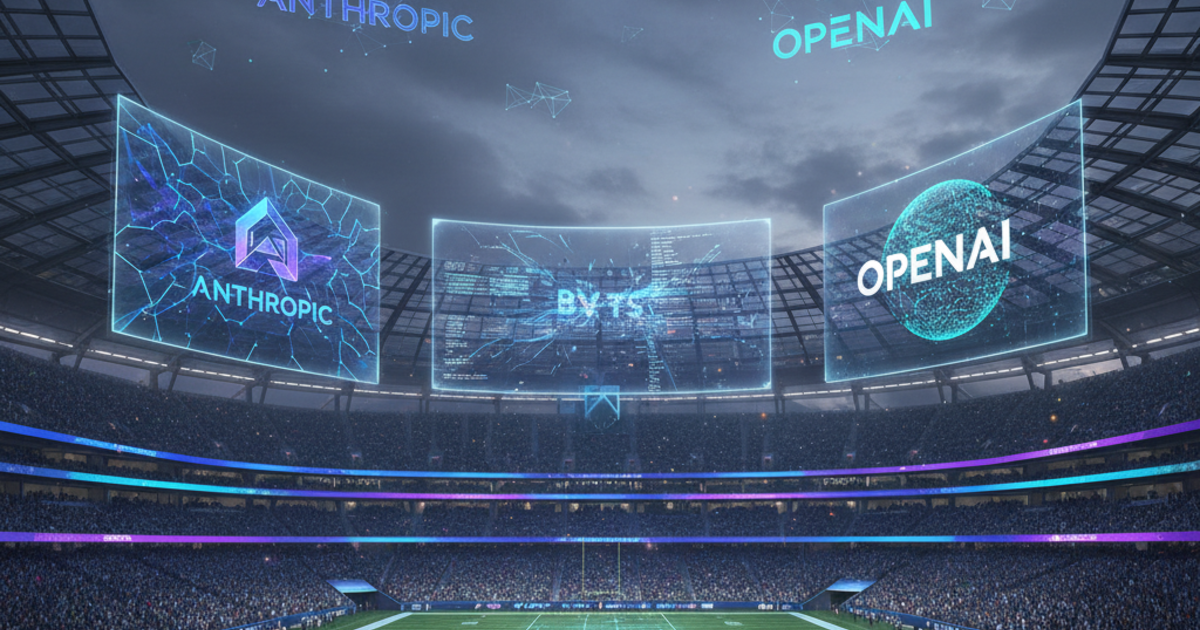
Let’s be honest: nobody tuned into Super Bowl LX expecting to witness the AI industry’s coming-of-age moment.
But that’s exactly what happened. While the Seattle Seahawks were busy dismantling New England and Bad Bunny was owning the halftime show, something far more significant was unfolding in the commercial breaks. Nearly a quarter of all Super Bowl LX ads featured AI in some way. Not crypto. Not cars. Not beer. AI.
And right at the center of it all? Two companies that used to settle their differences through benchmark scores and research papers were suddenly airing attack ads during the most-watched television event on the planet.
Welcome to AI’s mainstream era. It arrived with a $8 million price tag per 30-second spot, a public beef between two CEOs, and a fake news scandal. Nobody said growing up was elegant.
TL;DR — The Quick Take
Super Bowl LX 2026 saw AI’s mainstream moment: ~25% of ads featured AI. Anthropic attacked OpenAI over ads in ChatGPT, OpenAI responded with aspirational builder messaging. Best for marketing professionals, AI industry watchers, and business strategists. Price: free analysis. Skip if you don’t follow AI industry dynamics. Key takeaway: AI has entered mass-market competition phase—no longer just research labs.
The Main Event: Anthropic Goes Nuclear
Anthropic — the safety-focused AI company that has historically positioned itself as the “responsible adult in the room” — came out swinging with not one, but several Super Bowl spots that were anything but restrained.
The ads carried headlines like “Deception,” “Betrayal,” “Treachery,” and “Violation.” The main 30-second spot? A scrawny guy asking a buff trainer, “Can I get a six pack quickly?” The trainer starts giving helpful AI-chatbot-style advice, then smoothly pivots into… an ad read. Mid-conversation. Without warning.
The tagline that aired: “There is a time and place for ads. Your conversations with AI should not be one of them.”
If you’re wondering who exactly Anthropic was targeting — well, the company insists it wasn’t about “any other company.” Anthropic president Daniela Amodei said as much on Good Morning America with a straight face that deserves its own acting award.
Because let’s be real: everyone knew this was about OpenAI’s decision to bring advertising into ChatGPT. And judging by the reaction, the message landed.
The numbers don’t lie. Anthropic’s ad generated higher positive sentiment (25.5% positive posts vs. 16.3% for OpenAI, per Meltwater). The YouTube preview racked up over 402,000 views before the game even aired. People were talking about it, sharing it, and — most importantly — laughing at it.
Interestingly, the version that aired was actually toned down from the original teaser. The pre-game version said “Ads are coming to AI. But not to Claude” — a much more direct shot. Someone in Anthropic’s legal department apparently had a productive Friday.
OpenAI’s Response: “You Can Just Build Things”
OpenAI’s counter-strategy was the polar opposite: earnest, aspirational, and completely devoid of trash talk.
Their 60-second spot showcased Codex, their coding agent, with the message that anyone — anyone — can be a builder. The ad featured a montage of hands reading, sketching, designing, and guiding robotic arms. It was polished, optimistic, and exactly the kind of thing you’d expect from a company spending billions to become the default AI platform.
It was also, let’s be honest, kind of forgettable.
The ad faced some embarrassing scrutiny too. The top viral post about OpenAI’s commercial? Someone pointing out that a Windows laptop in the ad was displaying the macOS ChatGPT app. In the age of AI, apparently nobody caught a basic continuity error. The jokes wrote themselves.
But here’s what’s interesting about OpenAI’s approach: they didn’t take the bait. While Sam Altman had been very vocal pre-game — calling Anthropic’s ads “funny” but “clearly dishonest” — the actual ad rose above the fray. Altman’s X post framed the philosophical divide perfectly: “Anthropic serves an expensive product to rich people. We are glad they do that… but we also feel strongly that we need to bring AI to billions of people who can’t pay for subscriptions.”
That’s the real strategic tension here, and we’ll come back to it.
The Supporting Cast: Everyone Else Who Showed Up
Anthropic and OpenAI were the headliners, but the undercard was stacked:
Google continued its AI push after last year’s infamous Gemini ad that fumbled a Gouda cheese fact. This time around, they kept things safer — lesson learned.
Amazon unveiled Alexa+ with a Chris Hemsworth-fronted satirical spot. Classic Amazon move: use a massive celebrity to make an AI assistant feel warm and human.
Meta went with AI-assisted Ray-Ban glasses for extreme activities. Because nothing says “the future” like asking an AI what you’re looking at while skydiving, apparently.
AI.com — the rebrand from Crypto.com’s Kris Marszalek — ran a 30-second spot dangling premium handles like “Mark,” “Sam,” and “Elon.” The pitch? Mainstream AI agents for everyone. If you’re getting déjà vu from the crypto Super Bowl era… you’re not wrong, and we should probably talk about that.
Svedka made history as the first brand to air a fully AI-generated Super Bowl ad. The verdict from The Verge and basically everyone else? The AI-generated ads were, collectively, terrible. Cheaper and faster to produce, sure. But the overall quality had “an undeniable cheap and sloppy quality” that made the human-produced ads look even better by comparison.
Genspark, Wix, and other smaller AI companies also grabbed spots, filling in what used to be automaker territory. The shift is tectonic.
The Subtext: What the Messaging Actually Reveals
Strip away the production values and celebrity cameos, and you’ll see something fascinating: every major AI company chose a fundamentally different narrative for the biggest advertising stage on earth. That tells you everything about where this industry thinks it’s going.
Anthropic’s message: Trust us. We won’t exploit you. Their entire campaign was a values play — positioning Claude as the premium, privacy-respecting choice. It’s the Apple playbook: we’re expensive because we respect you.
OpenAI’s message: AI is for everyone. They’re playing the democratization angle, trying to be the Android to Anthropic’s iPhone. The ads-in-ChatGPT strategy is the revenue engine that funds free access.
Amazon/Google/Meta’s message: AI is already in your life — just let us do more. These aren’t AI companies pitching AI. They’re consumer brands wrapping AI into products you already use.
AI.com’s message: Get in early. This is pure crypto energy — FOMO-driven, handle-grab urgency. The fact that it’s the same CEO who ran Crypto.com’s Super Bowl blitz three years ago isn’t a coincidence. It’s a playbook.
The Drama: When AI Companies Start Beefing
Let’s talk about the elephant in the room: AI companies are now publicly fighting each other in front of 120 million viewers.
This is new. And it matters.
For years, the Anthropic-OpenAI rivalry played out in research papers, benchmark scores, and the occasional passive-aggressive blog post. The backstory adds extra spice — Anthropic was literally founded by former OpenAI employees (including CEO Dario Amodei) who left over safety disagreements.
But Super Bowl LX took it mainstream. Consider the escalation timeline:
- May 2025: Anthropic puts up San Francisco billboards reading “AI that you can trust” and “The one without all the drama” — widely read as OpenAI shade
- Pre-Super Bowl: Anthropic releases teaser ads directly referencing ads coming to AI
- Sam Altman responds on X, calling the ads “clearly dishonest”
- OpenAI president Greg Brockman calls a Reddit post about last-minute ad changes “fake news”
- Fabricated headlines circulate on X claiming OpenAI changed its ad at the last minute
- A parody website (“Claude With Ads”) gets created and goes viral
- OpenAI CMO Kate Rouch has to debunk a completely fabricated Ad Age article
This isn’t a benchmark war anymore. This is a brand war. And brand wars are where industries mature — or get ugly. Usually both.
The Crypto Parallel (And Why It Should Make You Nervous)
If you were watching in 2022, you remember the crypto Super Bowl. FTX had Larry David. Crypto.com had Matt Damon. Coinbase had a bouncing QR code. The message was clear: crypto has arrived.
We all know how that ended.
Now, I’m not saying AI is crypto. The technology is real, the use cases are tangible, and the revenue is legitimate. But the marketing energy is eerily similar: massive spending to create mainstream FOMO, an industry more focused on capturing users than proving value, and a land-grab mentality that prioritizes speed over substance.
The fact that Kris Marszalek — the actual CEO of Crypto.com — is now running the AI.com Super Bowl campaign should give everyone pause. Not because he’s wrong about AI, but because the playbook is identical.
The question isn’t whether AI is real. It is. The question is whether this level of marketing spend is a sign of confidence or a sign of desperation to acquire users before the next model release reshuffles the deck.
Why This Matters: AI’s Mainstream Moment
Here’s the thing: regardless of who “won” the ad war, the fact that it happened at all is the story.
AI companies are now consumer brands. They’re not pitching to developers and enterprises anymore — they’re pitching to your aunt who watches the Super Bowl for the commercials. When nearly 25% of Super Bowl ads feature AI, you’ve crossed the Rubicon.
This has massive implications:
-
The trust narrative is the new battleground. Anthropic just proved you can win a news cycle by positioning yourself as the ethical choice. Expect every AI company to start competing on trust, not just capability.
-
Advertising inside AI is the next trillion-dollar question. OpenAI’s ad-supported model is a bet that AI chatbots become the new search engines. Anthropic’s counter-bet is that users will pay a premium to avoid that. Sound familiar? It’s the Google vs. Apple privacy debate, reloaded.
-
The AI agent race is officially on. Both OpenAI (Codex) and AI.com were pitching AI agents — not chatbots, not search tools, but autonomous agents that do things for you. The Super Bowl is where this messaging went mass-market.
-
Brand matters now. For years, AI companies competed on benchmarks. Now they’re competing on vibes. Anthropic is “the trustworthy one.” OpenAI is “the one for everyone.” This branding will stick longer than any MMLU score.
What Happens Next
Let’s make some predictions:
Short term (weeks): Expect a measurable bump in Claude signups from the Super Bowl campaign. OpenAI will likely accelerate its ads-in-ChatGPT timeline to prove the model works. AI.com will see a flood of handle registrations that may or may not translate to actual usage.
Medium term (months): The Anthropic “no ads” pledge becomes a key differentiator that other companies have to respond to. Google and Meta quietly figure out how to position their AI wrappers against the pure-play AI companies. The AI-generated ad backlash forces brands to think twice about cutting production budgets.
Long term (2026-2027): We’ll look back at Super Bowl LX the way we look back at Apple’s 1984 ad or the dot-com Super Bowl blitz of 2000. It was the moment AI stopped being a technology and started being a culture. Whether that’s a good thing depends entirely on whether these companies deliver on the promises they just made to 120 million people.
The Bottom Line
Super Bowl LX wasn’t just a football game. It was AI’s debutante ball — complete with drama, backstabbing, fake news, and a vodka brand that probably shouldn’t have let a robot make its commercial.
Anthropic won the night on social media. OpenAI won on ambition. And everyone in the AI industry collectively agreed that the era of quiet, under-the-radar competition is over.
The real question isn’t who won the Super Bowl ad war. It’s this: in five years, will we look back at this moment as the beginning of AI’s golden age — or as the peak of its hype cycle?
If you’re building with AI, the answer matters a lot. If you’re just watching from the sidelines, grab some popcorn. This is going to be one hell of a show.
What did you think of the AI Super Bowl ads? Did Anthropic go too far, or did they nail it? Drop your take in the comments or find us on Twitter/X.